

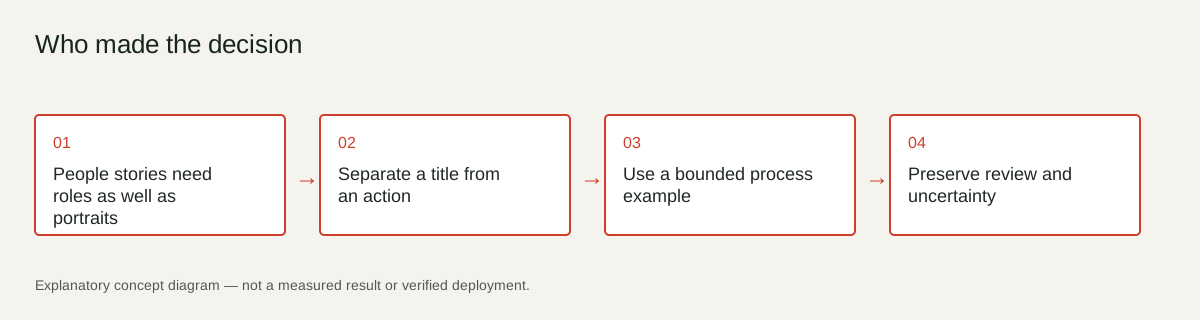
People stories need roles as well as portraits
A compelling photograph cannot explain who had authority, who offered advice and who was affected by a decision. Begin by mapping roles. This gives a people-focused story substance without inventing a quotation, interview or heroic individual narrative.
Separate a title from an action
A public job title may be relevant background, but it is not proof that the person personally approved every operational step. Look for the record supporting a specific action. If an organisation describes a collective process, do not quietly convert it into a single-person achievement or failure.
Use a bounded process example
Imagine a team selecting a new internal tool. One person proposes it, another controls access, a third reviews procurement conditions and others test the workflow. This is illustrative. A useful account asks which decision belonged to which role and what evidence records that responsibility.
Preserve review and uncertainty
NIST’s AI risk-management materials provide one example of why responsibilities and context matter when technology is used in an organisation. They do not establish the governance of any individual company. [I01] Report only the role relationships supported by the actual sources available to the publication.
Publish a fair account
Give readers the relevant decision, evidence and limits. Obtain appropriate permissions for real interviews and portraits, verify quotations and offer a proportionate correction route. Until such reporting exists, use clearly labelled explanatory or conceptual material rather than implying a real person has spoken to the site.
Sources
- NIST AI Risk Management Framework — Context for bounded pilot evaluation.
Sources and further reading
- NIST AI Risk Management Framework ↗
Context for bounded pilot evaluation
Check the original document for its scope, date and current status.
Something needs a closer look?
Suggest a correction