
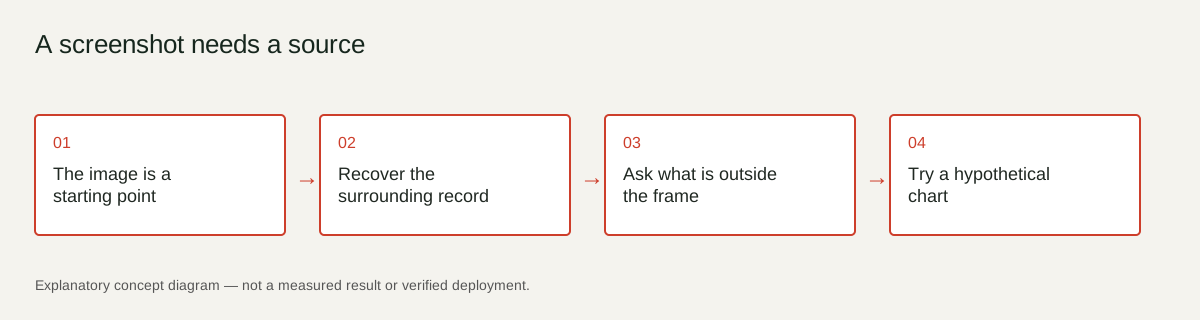
The image is a starting point
A screenshot can show what was visible within a captured view. It may omit the surrounding document, the date, a filter or a later correction. Treat it as a route to the source rather than assuming that everything needed to interpret it is inside the image.
Recover the surrounding record
Look for the original page, publication context and relevant period. If a chart appears in a filing, retrieve the actual document rather than relying only on a cropped social post. The SEC’s guide to reading a 10-K is an example of how document structure helps restore context for material within that filing type. [I05]
Ask what is outside the frame
A table may depend on a note below the crop. A comparison may hide a changed unit. A statement may be followed by a qualification on the next line. These are reasons to inspect the original, not reasons to accuse the person sharing the image of bad faith.
Try a hypothetical chart
Imagine a chart whose title refers to one period while a social caption describes another. The chart and caption may each be readable, yet their combination can mislead. This is an illustrative example. A useful correction would identify the period mismatch and link the complete source, rather than merely posting a competing crop.
Share the trail with the image
When permission allows reproduction, retain a legible source reference and enough context to support the point being made. Mark unavailable evidence as unavailable. If the original cannot be found, do not upgrade the screenshot into verified reporting. The useful result may be a narrower claim or a decision to wait.
Sources
- SEC How to Read a 10 K — Covered US filings; not all company reporting.
Sources and further reading
- SEC How to Read a 10 K ↗
Covered US filings; not all company reporting
Check the original document for its scope, date and current status.
Something needs a closer look?
Suggest a correction