

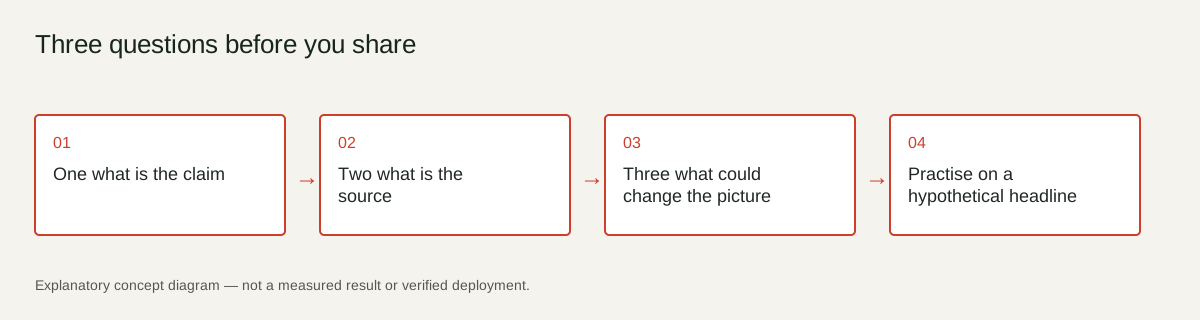
One what is the claim
Write the statement in one sentence. Distinguish an event, an interpretation, a forecast and a promise. A headline may combine several of them. Until the claim is clear, it is difficult to know what evidence would support it or which missing context matters.
Two what is the source
Identify the original record or first-hand account where possible. A company statement establishes what the company said; a filing or technical report may answer another part of the question. A summary can help a reader find the source, but it should not erase the distinction between evidence and interpretation.
Three what could change the picture
Check the date, comparison, definition and relevant commercial relationship. A materially connected endorsement deserves appropriate disclosure; FTC guidance provides one US reference for understanding that relationship. [I04] This is a context question, not a presumption that a commercial relationship makes every statement false.
Practise on a hypothetical headline
Suppose a new service is described as transforming work. Ask whether the supporting material describes availability, a small trial or a measured outcome. The three-question method does not produce a truth score. It produces a shorter, more careful explanation of what you can reasonably repeat and what should remain qualified.
Make the next step useful
Link the original source, retain the relevant date and avoid turning uncertainty into either automatic belief or automatic dismissal. If the claim concerns professional advice, personal allegations or another high-consequence subject, a general reading checklist is not enough on its own. Pause for the appropriate expertise and evidence.
Sources
- FTC Disclosures 101 — Material connections; not global legal advice.
- SEC EDGAR search — US filing coverage; not a worldwide company register.
Sources and further reading
- SEC EDGAR search ↗
US filing coverage; not a worldwide company register
- FTC Disclosures 101 ↗
Material connections; not global legal advice
Check the original document for its scope, date and current status.
Something needs a closer look?
Suggest a correction
