

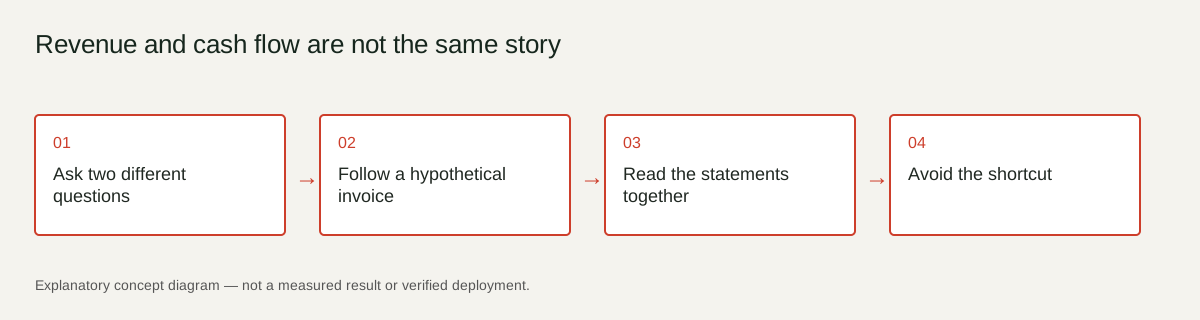
Ask two different questions
Revenue and cash flow help readers ask different questions about a business. They should not be swapped merely because both are expressed in money. A careful introduction explains the measure being discussed and directs the reader to the relevant statement and accounting context.
Follow a hypothetical invoice
Imagine a service completing work and issuing an invoice, while payment arrives later. This is a simplified illustration, not a complete accounting example or a statement about a real company. It shows why the timing of recognised activity and the timing of cash movement can differ. The actual treatment depends on the reporting rules and circumstances.
Read the statements together
The SEC’s beginners’ financial-statement guide introduces the distinct roles of the income statement and cash-flow statement. Use it as a starting point for understanding relationships, not as proof of a particular company’s health. [I06] Company-specific interpretation requires its actual records, definitions and notes.
Avoid the shortcut
A positive movement in one measure cannot settle every question about liquidity, profitability or the sustainability of operations. Ask which period is covered, what transactions are included and what the notes qualify. Do not draw a conclusion from a decontextualised screenshot of a single number.
Keep a three-question checklist
What does the measure count? When is it recorded? Which other statement adds the missing perspective? Those questions help a general reader pause before repeating a financial headline. This article provides reading context and is not an accounting opinion, investment recommendation or assessment of any named business.
Sources
- SEC Beginners Guide to Financial Statements — General reading concepts; no company assessment.
Sources and further reading
- SEC Beginners Guide to Financial Statements ↗
General reading concepts; no company assessment
Check the original document for its scope, date and current status.
Something needs a closer look?
Suggest a correction
